Vibro-Acoustics
Structural acoustics or vibro-acoustics is the study of structural vibration and fluid structure interaction leading to the radiation of sound. Structure borne sound is a well known vibro-acoustic phenomenon but in fact most airborne sound sources can also be considered from the same vibro-acoustic viewpoint.
At Salford we are equipped with state of the art facilities, equipment and a broad range of vibro-acoustic measurement methods, many of which are unavailable elsewhere. Using these methods it is possible to diagnose and fix vibro-acoustic problems or assist product design.
What we offer:
Transfer Path Analysis (TPA) – TPA is an advanced methodology for identifying dominant vibrational transfer paths within a system, enabling the rank ordering of source contributions and providing accurate guidelines for the provision of engineering solutions. TPA has been widely adopted within the automotive and aerospace industries, where understanding noise and vibrational behaviour is critical for informing design choices. A key strength of TPA is that there are several ways of approaching the analysis depending on the particular problem to be solved. In particular, the in-situ and component-based methods provide detailed solutions to engineering challenges, whether the analysis needs to be performed under real operating conditions or the system needs to be divided and components characterised independently.
- Virtual point transformation
- Blocked force identification
- Forward response prediction
- Identification of transfer paths
- Rank source contribution
Vibroacoustic Virtual Prototyping (VAVP) – VAVP involves the creation of a computational model made up of the subsystems of a larger system. To achieve this, each component requires individual characterisation – this can be completed experimentally, analytically, or numerically. Using dynamic substructuring, the individual components are coupled together, and a computational model can provide predictions of the coupled system without the need for a full experimental test rig.
- Substructure decoupling
- Finite element modelling (FEM)
- Vibroacoustic prototype response prediction
- CAD and 3D modelling
Uncertainty Analysis – Understanding the limits of a prediction is critical to any robust engineering process. The analysis of uncertainty enables confidence intervals to be drawn, offering assurance in the engineering solution.
- Monte Carlo analysis
- Covariance based uncertainty framework
Isolator characterisation – Vibration isolators are critical components in machinery design, used to reduce the transmission of unwanted vibrations and noise from
equipment to surrounding structures. Proper characterisation of these isolators enables engineers to select, design, and tune mounts so that they perform effectively under real operating conditions.
- Dynamic stiffness
- Mount resonance characteristics
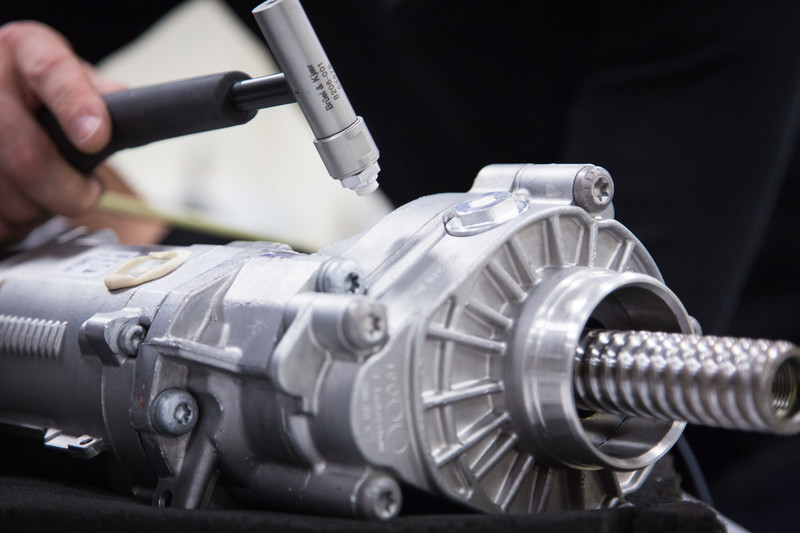
Instrumentation and tools
- DAQ analysers and multichannel acquisition
- Impact hammer and accelerometer modal analysis
- Laser Doppler Vibrometer (LDV)
- Scan and paint acoustic intensity
- Low-noise microphones
- Near-field acoustic holography
Typical engagement workflow
- Problem Scoping
- Define source and receiver structures, identify suitable test rig design, identify remote points of interest on receiver, define frequency range.
- Literature review to inform on the state of the art in measurement process.
- Test design
- Axis definitions, sensor placement, interface definitions, identification of optimal placement and numbers of virtual points due to number of excitations and responses
- Identify best measurement tools
- Measurement
- FRF measurements, blocked force extraction, measurements to facilitate uncertainty acquisition.
- Iterative and informed by the validation steps included within the processing steps.
- Post processing
- Generation of plots using the measurements to make informed opinions on the measurement campaign
- Deliverables
- Presentations, reports, training.
The team
| Dr Joshua Meggitt | j.w.r.meggit1@salford.ac.uk |
| Dr Lucy Barton | l.s.barton1@salford.ac.uk |
| Mr Gabriel Whittle | g.whittle3@salford.ac.uk |
General Enquiries
t. +44 (0)161 295 3814
e. acoustic.testing@salford.ac.uk