This pair of presentations can now be watched back at https://youtu.be/p5qbOSQuor8.
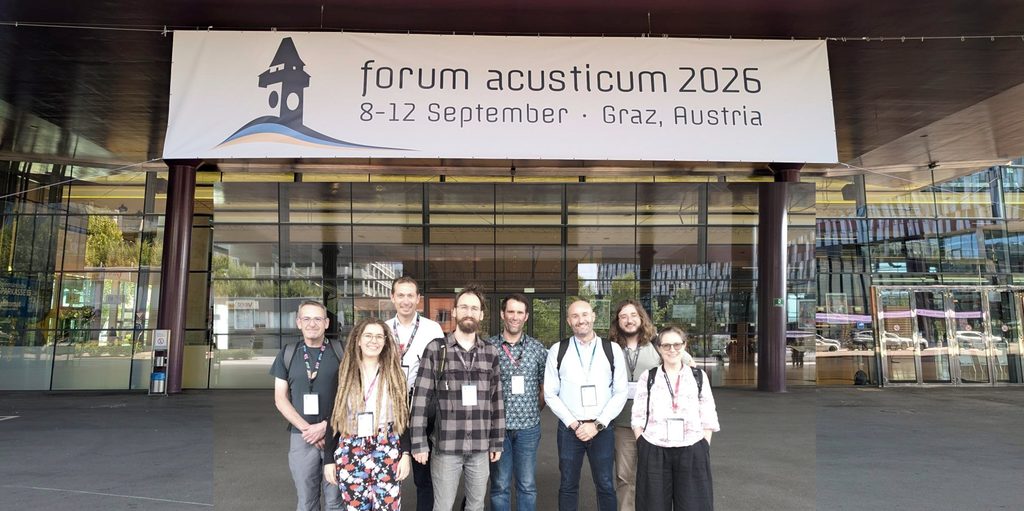
We had a strong representation at Forum Acusticum in Graz this year, with 14 papers and posters lead-authored by Salford researchers. This week our lunchtime seminar gives you the chance to hear about some of the new research that was disseminated there. It will take place in Newton 241 12-1pm, but will also be streamed live on Teams via this link.
Presentations
AN EXPERIMENTAL STUDY OF HIGH AMPLITUDE SHOCK NOISE FROM EXPLOSIVE DEPTH HARDENING
Zachary Simcox et al. Read the paper here.
Explosive Depth Hardening (EDH) is an industrial process in which plastic explosives are used to compress and work-harden steel. Depending on the steel that needs hardening, the energy equivalent of up to 10 kg of TNT is used. Depending on the shipments, between one and 4 rails are hardened simultaneously. The nearest noise sensitive receptor is approximately 2 km from the source, and under specific weather conditions, EDH has the potential to exceed 130 dB(C)peak at this location. This noise source is also known to be audible and identifiable at receptors more than 10km away. In this study, a comprehensive measurement campaign has been undertaken to investigate the propagation of the pulse in the non-linear and linear acoustic regions. These field trial measurements were conducted in-situ on the DNV Spadeadam site during their usual daily operations. The characteristics of the blast wave, including peak pressure, shock duration, and shock speed, have been measured using piezoelectric pressure sensors.
A Surface-Based Geometrical Acoustics Algorithm Including Diffraction (if time allows)
Jonathan Hargreaves. Read the paper here.
Raytracing is an established method for computing the late-time part of room impulse responses, but it has the drawback that only very crude Monte Carlo models of boundary scattering and diffraction are possible to include without it losing its attractive computational cost scaling. This happens because higher-resolution models of these processes output multiple child rays for every parent ray received, making the number of rays grow with reflection order. An emerging solution is so called ‘Surface-Based’ Geometrical Acoustics (SBGA). Here the distribution of rays arriving at a boundary is mapped onto a predefined set of spatial elements and angular interpolation functions, producing a vector of coefficients. Re-radiation of subsequent reflections is then a matrix multiplication, with the steady state being solvable via a Neumann series. Since rays only ever propagate one reflection order before being collected, diffraction and scattering processes that cause them to multiply can be included without issue. In this paper an approach to efficiently represent edge diffraction in such algorithms is presented. It involves
discretising the sound energy arriving and departing an edge versus angle and representing the diffraction via a matrix multiplication relating these coefficients. Indicative results demonstrate the approach.
TOWARDS THE EVALUATION OF COMPLEX ACOUSTIC ENVIRONMENTS USING SOUND SOURCE SEPARATION METHODS (cancelled due to illness)
Sean Kenji Cragg et al. Read the paper here.
Perception of a soundscape is shaped significantly by the dominant sound sources present in an acoustic
environment. Spatial characteristics have also been suggested to influence how a soundscape is perceived. Soundscape recordings are often analysed holistically rather than at the level of individual sources; the ability to separate and analyse sources individually could enable deeper insight into how specific sources drive overall perception. Spatial audio formats are commonly used in sound scape assessment, yet a source stripped of its directional character cannot be used to investigate spatial contributions to perception, or re-rendered for listening experiments. The preservation of spatial characteristics, however, appears to be relatively unexplored for the task of universal sound separation.
This paper presents a minimal modification of ConvTasNet to accept and output first-order ambisonic (FOA) signals for universal sound separation (separating sources of any class), comparing three loss functions (SNR, SI-SDR, and a multichannel SI-SDR variant) for FOA-to-FOA separation. Results indicate that the multichannel SI-SDR loss substantially improves both separation performance and preservation of source direction compared with conventional SI-SDR and SNR losses. These early-stage findings suggest spatially-preserving source separation may hold promise as a tool for future soundscape studies.
The following will also be available as a poster for on-campus attendees:
A Field Study of Air Source Heat Pump Noise Levels and Propagation in a UK Housing Development
Future Homes Team. Read the associated technical report here.
Net Zero targets in the UK require a shift to low or zero carbon emission technology, which is supported by the UK government funding to support the installation of Air Source Heat Pumps (ASHPs) for domestic heating provision. ASHPs offer better thermal efficiency than traditional boiler systems and have no direct carbon emissions. Research and planning policy is needed, however, to ensure that noise generation stays within accepted levels. For ASHP installation in existing dwellings, the MCS 020a ‘Air Source Heat Pump Sound Calculation’ standard is used by installers to validate if an installation can proceed under permitted developments rules, or whether a full planning assessment is required. Having to undertake the latter is a barrier to adoption, so there is a need to ensure MCS 020a is not unduly stringent. But on the other hand, if it were not stringent enough then that could lead to noise complaints. There is, therefore, a need to validate that MCS 020A is fit for purpose, and this field study tests this objectively by comparing it to operational ASHP noise measurements. This poster will report the design of the study, the analyses undertaken, and signpost the key results and conclusions.